Coaching Credibility Signals Explained for Coaches

Coaching credibility signals are visible indicators that communicate your competence, trustworthiness, and relevance to prospective clients before they ever book a call. Getting coaching credibility signals explained clearly matters because credibility is the primary factor in client acquisition, built on three core elements: relevant experience, clarity of process, and measurable outcomes. Coaches who present these signals clearly and consistently win clients faster. Those who bury them, or skip them entirely, watch prospects quietly move on. This guide breaks down every signal type, shows you where coaches go wrong, and gives you a practical framework for building credibility that converts.
What are the key types of coaching credibility signals?
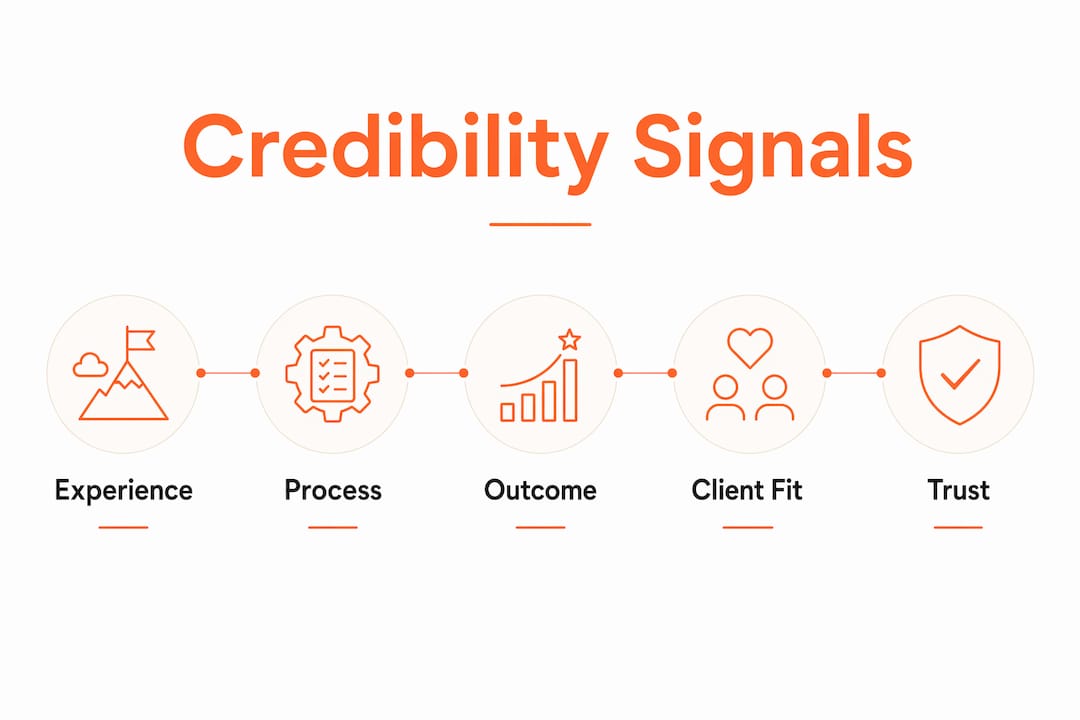
Coaching credibility signals fall into three distinct categories: experience signals, process signals, and outcome signals. Each category answers a different question in the prospect's mind. Together, they create a complete picture of why you are the right coach for the right client.
Experience signals
Experience signals tell prospects you have done this before with people like them. They include certifications from recognized bodies like the International Coaching Federation (ICF), niche expertise in a specific industry or life stage, and a clear description of the client types you have worked with. A health coach who lists "ICF-certified, specializing in burnout recovery for corporate women" communicates far more than one who simply says "certified coach." Specificity is the signal. Vague credentials read as filler.

Process signals
Process signals show prospects exactly how you work. A documented methodology, named coaching stages, and a clear client journey description all reduce the uncertainty that kills buying decisions. Buyers value clarity about who coaching is for, what problems it solves, and what milestones look like. When you describe your process in concrete steps, you replace anxiety with confidence. Prospects stop wondering what they are paying for and start imagining the result.
Outcome signals
Outcome signals are the proof layer. Case studies, measurable client wins, and progress tracking data all belong here. High-trust credibility signals combine outcome proof with implementation proof, and skeptical buyers prioritize evidence-based messaging such as progress dashboards and detailed methodologies over generic testimonials. A testimonial that says "Sierra changed my life" is weak. A case study that shows a client went from a stress score of 8/10 to 3/10 in 90 days is a signal.
Pro Tip: Add fit criteria to your coaching page. Naming who your coaching is NOT for signals professionalism and helps prospects self-select, which saves you both time.
| Signal type | What it communicates | Example |
|---|---|---|
| Experience | Relevant background and niche expertise | ICF certification, industry-specific client history |
| Process | How coaching works and what clients experience | Named methodology, stage-by-stage journey map |
| Outcome | Proof that coaching produces results | Case studies with baseline and result metrics |
| Social proof | Third-party validation of your work | Contextual testimonials with specific outcomes |
| Ethical boundaries | Honest limits and realistic expectations | Clear fit criteria, "typical result" language |
How do coaching credibility signals influence client trust?
Prospects evaluate coaches in a specific order: fit first, then competence, then proof. This sequence matters because no amount of impressive credentials will convert a prospect who does not first believe you understand their specific situation. Trust builds in layers, and each layer requires a different type of signal.
Specificity does the heavy lifting at the fit stage. When your messaging names a precise problem, a defined client type, and a realistic timeline, prospects recognize themselves in your work. Vague claims like "I help people reach their potential" create no recognition. Concrete language like "I help first-time managers stop feeling like impostors within six months" creates immediate resonance.
"Ethical marketing that communicates honest fit boundaries often converts better than hype-laden promises. Clients who self-select based on clear criteria arrive more committed and more likely to get results."
Communicating limits transparently signals professionalism and competence. When you tell prospects who you cannot help, you actually increase trust with the prospects you can help. It reads as confidence, not weakness.
The proof layer closes the decision. Values demonstrated through action build stronger trust than marketing claims alone. Transparent pricing, clear boundaries, and realistic outcome framing all function as trust signals. Prospects who see consistent behavior across your website, social content, and intake process experience what brand researchers call signal coherence. That coherence is what turns a curious visitor into a paying client.
- Fit signals: niche description, client type language, problem specificity
- Competence signals: certifications, methodology documentation, niche expertise
- Proof signals: case studies, progress dashboards, contextual testimonials
- Coherence signals: consistent messaging across all client touchpoints
Keep your messaging consistent across your website, social profiles, emails, and booking experience. A prospective client should be able to recognize the same approach and understand what you offer at every step.
Common pitfalls in building coaching credibility
The most common mistake coaches make is confusing visibility with credibility. Publishing daily content without a clear identity does not build authority. It builds noise. Credibility is often mistakenly equated with visibility, and content without identity clarity can actually dilute trust over time.
Here are the four pitfalls that undermine coaching credibility most often:
- Hiding your strongest signals. Many coaches bury certifications and client outcomes deep in their website instead of placing them on high-traffic pages. Your homepage and booking page are where decisions happen. Put your best proof there.
- Using hype-heavy language. Phrases like "life-changing results" and "transformation guaranteed" trigger skepticism in mature buyers. Outcome statements using "typical result" or "when implementation is consistent" signal credibility far better than guarantees.
- Skipping process documentation. Coaches who describe what they do but not how they do it leave a trust gap. A visible methodology description, even a simple three-stage framework, closes that gap immediately.
- Ignoring ethical transparency. Coaches who overpromise and underdeliver destroy trust permanently. Stating realistic ranges and honest limitations builds the kind of trust that generates referrals.
Pro Tip: Audit your homepage right now. If a prospect cannot identify your niche, your process, and one specific client result within 10 seconds, your credibility signals are not working.
Brand trust grows through consistent quality signals repeated across all client touchpoints, not one-off messages. Every email, social post, and sales page either reinforces or erodes the credibility you have built.
How to implement coaching credibility signals on your website
Your website is the single most important place to display credibility signals. Prospects visit it before they book, and what they find there determines whether they move forward. Here is how to implement each signal type effectively.
Certifications and credentials belong on your homepage above the fold and on your sales page near the call to action. Do not relegate them to an "About" page that most visitors never reach. Displaying your strongest credibility markers prominently on homepage and booking pages reduces perceived risk and speeds buying decisions.
Case studies are your most powerful outcome signals, but only when they include the right structure. Rapid credibility builds when you document client wins with five core elements: baseline metric, approach used, timeline, obstacles encountered, and final result. A stress score of 8/10 dropping to 3/10 over 12 weeks tells a story. "My client felt so much better" tells nothing. Establishing a baseline metric before coaching begins is the step most coaches skip, and it is the step that makes the before-and-after story credible.
Methodology documentation can live on a dedicated "How It Works" page or as a section on your sales page. Name your framework. Describe each stage. Show what clients experience at each step. Visible methodology descriptions and progress tracking dashboards improve perceived competence and client engagement.
- Place certifications on the homepage and booking page, not only on the About page
- Write case studies using the five-element structure: baseline, approach, timeline, obstacles, result
- Name and describe your coaching methodology in plain language
- Add fit criteria to your sales page so prospects can self-select
- Share client stories with context about their starting point, the work you did together, and the outcome.
- Audit all client touchpoints for signal consistency every quarter
| Implementation area | Credibility signal to add | Priority |
|---|---|---|
| Homepage | Certification badges, niche statement, one key result | High |
| Sales page | Case study, methodology overview, fit criteria | High |
| Booking page | Testimonial with context, realistic outcome language | High |
| About page | Client types served, credentials, coaching philosophy | Medium |
| Social content | Process transparency, client progress snapshots | Medium |
For more on how your website structure supports client acquisition, the coaching website trust signals guide at Sierra Lin Design walks through setup in detail.
Key Takeaways
Coaching credibility signals work because they answer the three questions every prospect asks: Do you understand my situation? Do you know what you are doing? Can you prove it?
| Point | Details |
|---|---|
| Credibility drives acquisition | Prospects evaluate fit, competence, and proof in that order before deciding to hire a coach. |
| Signal placement matters | Certifications and case studies belong on high-traffic pages, not buried in secondary sections. |
| Specificity builds trust | Naming your niche, process, and realistic outcomes converts better than vague transformation claims. |
| Case studies need structure | Effective client wins include a baseline metric, approach, timeline, obstacles, and final result. |
| Consistency seals trust | Credibility signals must appear across every client touchpoint, not just the homepage. |
What I have learned about credibility that most coaches overlook
Here is the honest truth I have seen working with coaches on their Kajabi websites: most credibility problems are not content problems. They are clarity problems. Coaches often have impressive credentials, real client results, and a genuine methodology. The problem is that none of it is visible where it needs to be, and none of it is framed in language that a prospect can immediately understand.
The coaches who convert best are not always the most experienced. They are the ones who have taken the time to organize their proof, name their process, and speak directly to a specific person with a specific problem. That clarity is a signal in itself. It tells prospects, "This person knows exactly who they help and how."
I also want to push back on the idea that credibility is something you build once and then have. It is a living thing. Every new client result is a new signal. Every piece of content either reinforces or contradicts the identity you are building. The coaches I see struggle most are the ones who treat credibility as a launch task rather than an ongoing practice. Refine your signals every quarter. Update your case studies. Revisit your fit criteria as your niche sharpens.
One more thing: ethical transparency is not a weakness. Telling prospects what you cannot help them with, framing outcomes with realistic ranges, and being honest about your process are the signals that attract the clients who actually get results. Those clients become your best case studies. That is how credibility compounds.
How Sierra Lin Design helps coaches present their credibility
Your credibility signals are only as effective as the website that displays them. A coaching website that buries your certifications, skips your methodology, and leads with vague copy is working against you, no matter how strong your actual results are. Sierra Lin Design builds custom Kajabi websites for coaches that put your strongest signals front and center, from homepage to booking page. Every design decision is made with client trust and conversion in mind. If you are ready to build a website that actually reflects the quality of your coaching, explore the free Kajabi templates to get started, or check out custom Kajabi web design services for a fully tailored build.
FAQ
What are coaching credibility signals?
Coaching credibility signals are visible indicators that communicate your experience, process, and results to prospective clients. They include certifications, case studies, methodology descriptions, and fit criteria.
Why does coaching credibility matter for client acquisition?
Credibility is the primary factor in client acquisition. Prospects evaluate fit, competence, and proof before deciding to hire a coach, so clear signals at each stage directly influence conversion.
How do I establish coaching credibility quickly?
Document three structured client wins using a five-element format: baseline metric, approach, timeline, obstacles, and result. Place these case studies on your homepage and sales page where prospects will see them immediately.
What makes a coaching testimonial credible?
A credible testimonial includes a specific problem, a measurable outcome, and a realistic timeframe. Generic praise like "amazing coach" carries far less weight than a result-focused statement with context.
Where should I display my coaching credibility signals?
Place your strongest signals, including certifications, case studies, and methodology descriptions, on your homepage and booking page. These are the highest-traffic pages where buying decisions actually happen.
Recommended
 Sierra Janisse · Kajabi Designer, Kajabi Expert, & Kajabi Website Designer
Sierra Janisse is a verified Kajabi Expert who helps online business owners build profitable websites on Kajabi. From SEO and copywriting to website design, branding, automations and funnel strategy, she is the go-to expert for Kajabi users who want to attract more clients and customers with their websites.

🚨Get the FREE Checklist
Skip the Kajabi tears—Swipe the free Website Checklist & Funnel Map
Exactly what should go where on your Kajabi site to maximize leads.