Kajabi Drip Content Explained for Coaches in 2026

Kajabi drip content is the practice of scheduling course lessons to release gradually over time rather than granting students immediate access to every module at once. This approach is the industry term for what Kajabi calls "drip scheduling," and it sits at the heart of how coaches and course creators control pacing, protect learner attention, and increase completion rates.
Kajabi combines course hosting, marketing automation, and payment in one platform, making it uniquely positioned to support structured drip delivery without requiring third-party tools. If you have ever wondered how to use Kajabi to deliver a course that keeps students engaged from week one through graduation, kajabi drip content explained is exactly where to start.
What is Kajabi drip content and how does the delivery workflow function?
Kajabi drip content delivery works through two primary scheduling methods, and understanding both is the foundation of every effective drip strategy. The first method releases content by a set number of days after a student's enrollment or purchase date. The second method releases content on specific calendar dates, regardless of when each individual student enrolled.
Drip content releases by days or calendar date, giving you full control over how your course unfolds. The "days after access" method works well for evergreen courses where students enroll at different times and each person follows their own personalized timeline. The "specific date" method is the better choice for cohort-based programs where you want every student to receive Module 3 on the same Tuesday morning.
Here is how the Kajabi drip content delivery workflow operates in practice:
- Days after enrollment: You set each section or post to unlock after a defined number of days from the student's access date. Day 0 is the day of purchase. Day 7 means the content unlocks exactly one week later.
- Specific calendar dates: You assign an absolute date to each module. Every enrolled student, regardless of when they joined, sees that content unlock on the same day. This powers synchronized cohort learning.
- Combination scheduling: You can mix both methods within a single course. For example, your welcome module unlocks immediately, your core content drips by days, and your bonus material unlocks on a fixed date tied to a live call.
- Access date overrides: Kajabi also lets you set an overall course access start date, which means students who purchase early do not see any content until the program officially begins.
Pro Tip: If you run live cohort programs, always use "Drip by Specific Date" for your core modules. It removes the confusion of relative timing and lets you plan live coaching calls around predictable content drops.
What are the best practices for a drip content strategy on Kajabi?
The most common mistake coaches make is treating drip scheduling as a technical checkbox rather than a pedagogical decision. Your drip schedule is your curriculum pacing plan. It determines how much cognitive load you place on a student each week and whether they feel supported or overwhelmed.

Choose your drip schedule around the amount of work each lesson requires and the support your students need. A short introductory course may need a quicker pace, while a deeper program may call for more time between modules. Leave room for practice, gather student feedback, and adjust the schedule when lessons feel rushed or too far apart.
Here are the best practices for building a drip content strategy that actually works:
- Align releases with learning milestones, not just the calendar. Each module should unlock when a student has had enough time to apply the previous lesson. A module on "setting your pricing" should not drop before the module on "defining your offer" has had time to land.
- Use cohort-based drip for synchronized learning. Cohort courses using 4, 8, or 12-week structures consistently outperform self-paced courses in completion and community engagement. Shared timelines create shared accountability.
- Keep each lesson focused on one outcome. Best practices include short videos and one actionable outcome per lesson, paired with community prompts and automated follow-up emails. This keeps students moving without feeling buried.
- Pair every content drop with an automated notification. Kajabi's built-in email automation lets you send a personalized email the moment a new module unlocks. Students who receive a "your new lesson is ready" email are significantly more likely to log in within 24 hours than those who have to remember on their own.
- Schedule live sessions around your drip calendar. If Module 4 drops on a Wednesday, hold your group coaching call on Friday. Students arrive having consumed the material and ready to ask real questions.
Pro Tip: Build your drip schedule in a spreadsheet before you touch Kajabi's settings. Map out every module, its release day or date, the automated email that goes with it, and the community prompt you will post. This "content calendar" approach prevents gaps and keeps your delivery running like clockwork.
How do advanced Kajabi drip features like locked progression enhance course delivery?
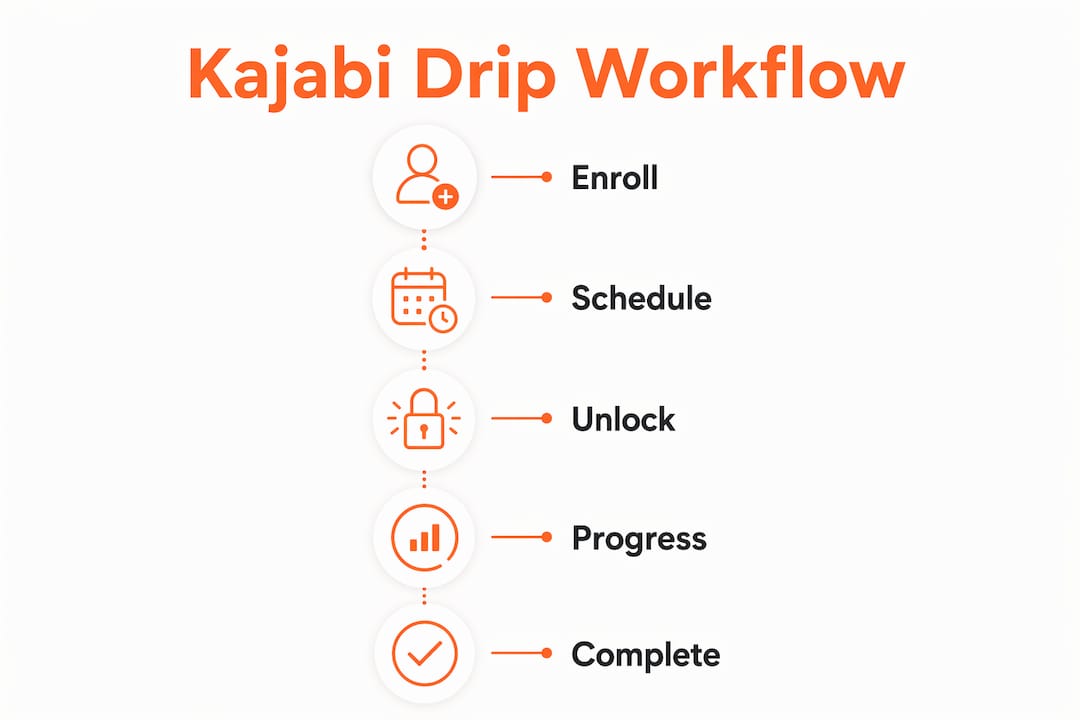
Locked progression is a separate but complementary feature to drip scheduling, and combining both is where Kajabi course delivery becomes genuinely powerful. Locked progression requires students to complete a lesson before the next one unlocks, regardless of how much time has passed.
This matters because drip scheduling controls when content becomes available, while locked progression controls whether a student can skip ahead within available content. Think of drip as your course's external clock and locked progression as its internal gatekeeper.
Here is where locked progression makes the biggest difference:
- Certification and training programs: Students must demonstrate completion of foundational material before advancing. This protects the integrity of your certification and ensures graduates actually earned it.
- High-ticket coaching containers: Locked progression signals to clients that your program has structure and standards. It positions your course as a serious investment, not a content library to browse casually.
- Sequential skill-building courses: When Lesson 2 builds directly on Lesson 1, allowing students to skip creates confusion and support requests. Locked progression eliminates this problem at the system level.
- Accountability programs: Combining drip timing with locked progression means a student cannot binge Module 3 before Module 2 has even unlocked. This enforces the pacing you designed.
"The most effective drip implementations use a balance of timed release and locked progression to control pacing while ensuring content mastery before advancement."
Combining locked progression with drip schedules increases course completion and ensures learners build on a solid foundation rather than skipping to the parts that feel most exciting. For coaches running premium programs, this combination is the difference between a course that transforms clients and one that collects dust.
What are the most common Kajabi drip content mistakes to avoid?
Even well-designed courses fail when the drip setup has gaps. The mistakes below are the ones I see most often when coaches come to Sierra Lin Design frustrated that their course is not performing the way they expected.
- Releasing content too fast. Dropping a new module every two days sounds generous, but it overwhelms students and spikes your refund rate. Weekly releases are the standard for a reason.
- Ignoring time zone differences. Aligning drip timing with learner time zones and peak engagement periods like Tuesday through Thursday mornings significantly improves open rates and lesson completion. A module that drops at 3 a.m. for your European students is a module they will forget about.
- Skipping automated notifications. Kajabi's automation tools exist precisely for this. An email sequence tied to each content drop is not optional if you want consistent engagement. Students need a nudge, not a scavenger hunt.
- Neglecting community engagement between drops. The space between content releases is where retention is won or lost. Post a discussion prompt in your Kajabi community the day a module drops. Ask students to share one takeaway. This turns passive consumption into active learning.
- Using relative drip timing for cohort programs. Transitioning from days-after-enrollment to calendar date-based drips improves cohort alignment and the overall student experience. Relative timing creates a fragmented cohort where everyone is on a different lesson. Calendar-based drip keeps the group together.
Pro Tip: Test your drip setup by enrolling a test account in your own course. Walk through the student experience from purchase to Module 1 unlock to the first automated email. You will catch broken triggers and missing notifications before your real students do.
Key takeaways
Kajabi drip content works best when timed release and locked progression are combined to control pacing and enforce mastery at every stage of your course.
| Point | Details |
|---|---|
| Two scheduling methods | Use "days after enrollment" for evergreen courses and "specific calendar date" for cohort programs. |
| Match pacing to program type | Mini-courses run 5 to 14 days; skill programs run 4 to 8 weeks; certifications run 8 to 12 weeks. |
| Locked progression adds accountability | Require lesson completion before the next module unlocks to protect course integrity and student results. |
| Automate every content drop | Pair each module release with a Kajabi email notification to drive timely student re-engagement. |
| Avoid time zone blind spots | Schedule content drops during peak engagement windows and account for your students' local time zones. |
Why I think most coaches underuse Kajabi's drip features
I have worked with dozens of coaches on their Kajabi builds, and the pattern is consistent. They set up a basic drip schedule, skip locked progression, and send zero automated emails when modules drop. Then they wonder why students are not finishing the course.
The Drip by Specific Date feature was a turning point for cohort management when Kajabi launched it, and it is still underused. Coaches who switch from relative to calendar-based drip tell me it transforms their live session quality because every student arrives at the call having seen the same material. That shared context makes coaching conversations richer and more productive.
Locked progression is the other feature coaches dismiss too quickly. I understand the hesitation. It feels restrictive. But for high-ticket programs, it is actually a selling point. Clients who pay $3,000 for a coaching container want to know there is a structure they cannot shortcut. Locked progression communicates that your program has standards.
My honest advice: treat your drip schedule as seriously as you treat your sales page. Both are client-facing. Both shape the experience your students have. A beautifully designed Kajabi site with a sloppy drip setup is like a stunning restaurant with slow service. The first impression does not survive the experience. You can explore more about Kajabi for coaches to see how the full platform supports structured, high-converting coaching programs.
Ready to build a Kajabi course that actually delivers?
At Sierra Lin Design, I build custom Kajabi websites and course structures specifically for coaches who want their programs to run with intention, not improvisation. If your drip setup feels patchy or your course is not converting the way it should, the fix is usually in the structure. Grab the free Kajabi templates to get a head start on a course layout that is already built for drip delivery. Or, if you are ready for a fully custom build that reflects your brand and automates your client flows, explore the custom Kajabi web design services designed specifically for coaches like you.
FAQ
What is Kajabi drip content?
Kajabi drip content is a scheduling feature that releases course lessons gradually over time rather than all at once. It is used by coaches and course creators to control pacing, improve completion rates, and manage the learner experience.
How do I set up drip content in Kajabi?
Inside your Kajabi product settings, navigate to each section or post and set a release delay in days after enrollment or assign a specific calendar date. Kajabi automatically unlocks the content for students when the trigger condition is met.
What is the difference between drip scheduling and locked progression?
Drip scheduling controls when content becomes available to students. Locked progression controls whether students can skip ahead within already-available content. Using both together gives you the strongest control over pacing and mastery.
How long should a Kajabi drip course be?
Mini-courses run 5 to 14 days, skill programs run 4 to 8 weeks, and certification or coaching programs run 8 to 12 weeks. Weekly module releases are the most common and effective pacing structure across all program types.
Can I use drip content for a cohort-based coaching program?
Yes. Use Kajabi's "Drip by Specific Date" feature to release modules on fixed calendar dates so every student in your cohort receives content at the same time, enabling synchronized live sessions and community discussions.
Recommended
 Sierra Janisse · Founder of Sierra Lin Design
Sierra Janisse is a verified Kajabi Expert who helps online business owners build profitable websites on Kajabi. From SEO and copywriting to website design, branding, automations and funnel strategy, she is the go-to expert for Kajabi users who want to attract more clients and customers with their websites.

🚨Get the FREE Checklist
Skip the Kajabi tears—Swipe the free Website Checklist & Funnel Map
Exactly what should go where on your Kajabi site to maximize leads.