The Role of About Page Coaches: Convert More Clients

Your About page is the single most visited page on your coaching website, and it either books clients or loses them. Up to 77% of coaching website visitors navigate to the About page before making any decision about booking. That number alone reframes how seriously coaches need to treat this page. The role of About page coaches play goes far beyond a short bio. It is the place where a prospective client decides whether you understand their problem, whether you can solve it, and whether they trust you enough to take the next step. This article covers what makes an About page work, how to structure it for both human visitors and AI search engines, and what most coaches get wrong.
What role does the About page play for coaches?
The About page is a coach's primary trust-building tool online. It is not a resume. It is not a timeline of your career. It is the page where a potential client asks, "Is this person for me?" and needs a clear, confident answer within seconds.
Trust is built or lost within 3 seconds based on the clarity of your opening message. That means your first sentence must speak directly to the person you serve, not to your own accomplishments. Coaches who lead with their certifications and career history miss this window entirely.

The importance of About pages in coaching businesses also extends to SEO and AI search. The About page often doubles as a primary landing page for AI-driven search results, which means it carries weight far beyond what most coaches realize. A well-structured About page can appear in AI-generated recommendations, putting you in front of prospective clients who never even searched your name.
Understanding the strategic role of your website helps you see the About page not as a formality, but as a conversion asset. Every word on it should serve your ideal client, not your ego.
What essential questions must a coach's About page answer?
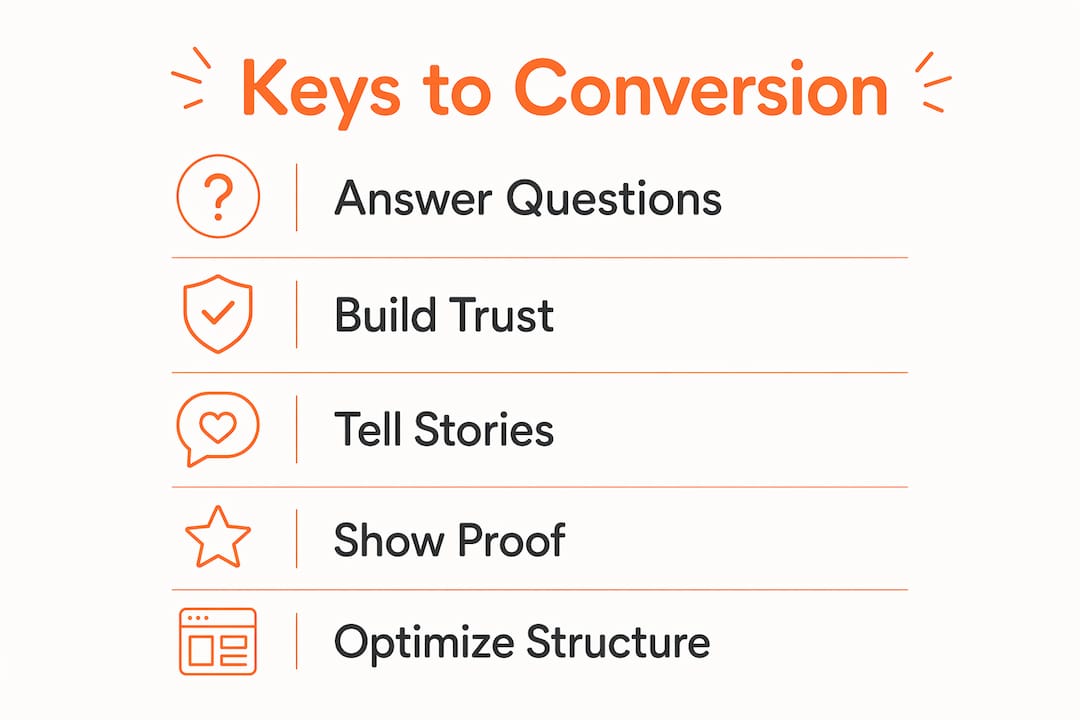
A high-performing About page answers four questions that every prospective client is silently asking. Miss any one of them, and you lose the visitor.
- Who do you help? Name your client profile specifically. "I work with mid-career women transitioning out of corporate" converts better than "I help people find their purpose."
- What results do you deliver? State outcomes, not activities. "My clients land senior roles within 90 days" is concrete. "I help you reach your potential" is not.
- Why are you the right person? Credentials matter, but your story matters more. Clients want to know you have lived experience with the problem you solve.
- What should they do next? A single, focused CTA outperforms vague invitations every time. One button. One action. Book a call, download a guide, or apply for a program.
The importance of About pages comes down to this: clarity converts. When a visitor can answer all four questions within 30 seconds of landing on your page, your booking rate rises.
Pro Tip: Write your About page headline as a direct statement of who you help and what they achieve. "I help burned-out executives reclaim their time and lead with confidence" tells the story before they read a single paragraph.
How to craft client-centered storytelling for your About page
Most coaches write their About page like a LinkedIn profile. They start with where they went to school, list every certification, and end with a vague invitation to connect. This approach converts poorly because it centers the coach, not the client.
The client-centered bridge technique flips this structure. Here is how to apply it:
- Open with the client's pain point. Start with the problem your ideal client is living right now. Make them feel seen before you introduce yourself.
- Introduce your methodology as the solution. Explain how your approach directly addresses that pain. This is where your framework or process earns its place.
- Share your story as proof. Your personal experience becomes credible only after the client sees you understand their struggle. Your story validates your method, not the other way around.
- Balance authenticity with professionalism. Share enough to be relatable. Do not overshare. A single vulnerable moment that connects to your client's experience is worth more than three paragraphs of personal history.
Clients look for authenticity and understanding on About pages, not just coach credentials. This is the shift that separates coaches who fill their calendars from those whose websites sit quietly in a corner.
Pro Tip: Read your About page draft and highlight every sentence that starts with "I." If more than 40% of your sentences begin that way, rewrite them to start with "you" or "your clients."
Why social proof and credibility signals matter on your About page
Social proof is not optional on a coaching About page. It is the mechanism that converts interest into action. 82% of consumers look for brands whose values align with their own, and testimonials are the fastest way to demonstrate that alignment.
Generic praise does not move the needle. Testimonials that include the client's name, title, and a specific outcome build far stronger trust. "This coaching changed my life" tells a visitor nothing. "After six months of working together, I negotiated a $40,000 salary increase and finally stopped second-guessing every decision" tells them everything.
Effective credibility signals to include on your About page:
- Outcome-specific testimonials with client names and roles
- Measurable results your clients have achieved, stated as concrete numbers where possible
- LinkedIn profile integration for third-party verification of your background and endorsements
- Professional affiliations or media features that a visitor can independently verify
Embedding your LinkedIn profile on your About page extends credibility through third-party verification. It signals that your qualifications exist outside your own website, which matters to skeptical buyers. Coaches who invest in trust signals on their coaching website see lower bounce rates and more discovery call bookings as a direct result.
How does About page structure affect client trust and AI visibility?
Structure is not just a design choice. It is a conversion and discoverability strategy. Structuring About pages with semantic headers and FAQs improves AI search citation and online authority. This means the way you organize your content determines whether AI tools like ChatGPT or Perplexity recommend you to prospective clients.
The table below outlines the core structural elements of a high-performing coach About page and what each one accomplishes.
| Page element | Purpose |
|---|---|
| Descriptive H2 headings | Help AI engines index your expertise and surface your page in relevant queries |
| FAQ content block | Captures long-tail search queries and increases AI citation probability |
| 400–600 word body copy | Matches the optimal reading time of approximately 2 minutes for About pages |
| Single CTA button | Reduces decision fatigue and drives one clear next action |
| Testimonial section | Provides social proof in a scannable format for fast-moving visitors |
Review your About page regularly so it reflects your current work and answers the questions prospective clients ask. Use descriptive headings and a clear structure to make your story, approach, and next steps easy to find.
The best practices for web design for coaches consistently point to one truth: structure and clarity are not separate from trust. They are the delivery mechanism for it.
Key Takeaways
An effective About page for coaches converts visitors into discovery calls by answering four client questions clearly, leading with client pain points, and using structured social proof and semantic content design.
| Point | Details |
|---|---|
| About page as trust hub | Up to 77% of coaching site visitors check this page before booking, making it your top conversion asset. |
| Client-centered storytelling | Lead with your client's pain point first, then introduce your story as proof of your method. |
| Social proof specificity | Testimonials with client names, titles, and measurable outcomes convert far better than generic praise. |
| Structural clarity | Use descriptive headings, FAQ blocks, and 400–600 words to improve both engagement and AI search visibility. |
| Single focused CTA | One clear call to action outperforms multiple vague invitations every time. |
What I have learned from working on coach About pages
After designing Kajabi websites for coaches across dozens of niches, I can tell you the most common About page mistake is not bad writing. It is misplaced focus. Coaches pour energy into their credentials section and leave the client's problem almost unaddressed. The visitor lands on the page, reads three paragraphs about certifications, and leaves without ever feeling seen.
The coaches whose About pages actually fill their calendars do something different. They write the first paragraph as if they are sitting across from their ideal client at a coffee shop. They name the exact frustration that client is carrying. They make the visitor think, "This person gets it." That moment of recognition is what keeps someone on the page long enough to read the testimonials, click the CTA, and book a call.
I also see coaches underestimate the AI visibility angle. In 2026, your About page is not just for human visitors. AI search engines index it, cite it, and recommend it. Coaches who structure their pages with clear headings and FAQ-style content blocks are showing up in AI-generated answers to queries their ideal clients are typing right now. That is a real competitive edge, and most coaches are leaving it on the table.
My advice: treat your About page like a living document. Revisit it every quarter. Update your testimonials, sharpen your client description, and check that your CTA still reflects your current offer. A page that was accurate a year ago may no longer represent who you serve or what you deliver. The coaches who keep this page current are the ones whose websites work for them around the clock.
Your About page deserves a design that works as hard as you do
A well-written About page still needs the right design to perform. If your Kajabi site has a layout that buries your story, hides your testimonials, or makes your CTA hard to find, the copy alone will not save it. Sierra Lin Design builds custom Kajabi websites for coaches that are designed from the ground up to convert. You can browse real client results in the Kajabi web design portfolio or get a site built specifically around your brand and client flow through the custom Kajabi web design services. If you want to start with a solid foundation right now, the free Kajabi templates are a practical first step.
FAQ
Why do coaches need a dedicated About page?
Up to 77% of coaching website visitors check the About page before booking, making it the primary place where trust is built or lost.
How long should a coach's About page be?
The optimal length is 400–600 words, which matches the average reading time of approximately 2 minutes that visitors spend on About pages.
What is the client-centered bridge approach?
It is a storytelling technique where you open with your client's pain point, introduce your methodology as the solution, and then share your personal story as proof of your approach.
How does an About page help with AI search visibility?
Semantic headers and FAQ content blocks increase the likelihood that AI search engines cite your About page in responses to relevant queries, expanding your reach beyond direct website traffic.
What social proof works best on a coaching About page?
Detailed testimonials that include the client's name, role, and a specific measurable outcome build significantly more trust than general praise.
Recommended
 Sierra Janisse · Founder of Sierra Lin Design
Sierra Janisse is a verified Kajabi Expert who helps online business owners build profitable websites on Kajabi. From SEO and copywriting to website design, branding, automations and funnel strategy, she is the go-to expert for Kajabi users who want to attract more clients and customers with their websites.
🚨Get the FREE Checklist
Skip the Kajabi tears—Swipe the free Website Checklist & Funnel Map
Exactly what should go where on your Kajabi site to maximize leads.